Edit 33:Michelin March
Three tables. One city. Delicious, deliberate research.
March was intentional this year.
I made a decision at the start of the month: I was going to eat my way through Charlotte's Michelin-recognized restaurants, one by one, and I was going to pay attention. Not just to the food—but to what it means that these places exist here, in a city that still gets introduced to the rest of the country as a finance hub. A tech corridor. Somewhere people move to for the square footage and the sensible commute.
And look—Charlotte is practical. Enthusiastically so. There's a particular kind of sameness that takes root when a city spends a long time catering to one very specific demographic and their very specific idea of a good time. Neutral interiors. Safe menus. The quiet suggestion that ambiance is a nice-to-have and beauty is, frankly, someone else's concern. You know the places. We all do.
But here's the thing—and this is the part worth leaning in for—something is shifting. Has been shifting, for those of us paying attention. The Michelin recognition is just the rest of the world catching up to what some of us already knew over here: there are people in this city building things that are genuinely, stubbornly, beautifully not that. Restaurants where the room feels considered. Where the food has a point of view. Where you leave feeling like someone actually thought about your experience from the moment you walked in.
This month, I ate at their tables. Three of them. It was research. Delicious, deliberate research.
Some evenings arrange themselves around the food. Others arrange themselves around the person across the table—and the food just happens to be extraordinary. This was the latter.
I shared the evening with a friend I met two years ago, when we were both just finding our footing in the Junior League. One of those connections where the ease is there from the very first exchange. It has only grown since—steadily, genuinely, in the way the best friendships do.
We sat at the chef's counter, our seating a long, elegant bench rather than stools—a design choice that somehow makes the whole experience feel more intimate, more considered. From where we sat we had a direct view of the entrance, and as the evening filled up we watched people pour in, the room coming alive around us. It was the perfect backdrop for the kind of conversation that loses track of time. And our bartender made sure we never had to think about anything else—the friendliest presence, warm and attentive, possessed of a particular skill I deeply appreciate: she knew my drink and would replace it seamlessly, without ever once interrupting the flow of conversation. That is its own kind of hospitality.
We started with the mojo duck empanada, highly recommended and immediately justified, and our conversation found its stride somewhere between the first bite and the last—enthusiastic, easy, the kind that bubbles right past the appetizer course.
Then the tagliatelle—each plate crowned with a glistening, creamy egg yolk that stopped us both mid-sentence. For me, it was a quiet callback to Japan, to meals I'd had there that carried this same unhurried richness. The kind that earns a moment of silence. We gave it one.
An off-menu strawberries and cream ice cream with crumbled honeycomb that I am still thinking about. It felt almost curated. Like someone knew.
And then dessert. An off-menu strawberries and cream ice cream with crumbled honeycomb. I adore honeycomb—the texture, the sweetness, the way it feels like a small and specific gift inside a dish—and this one felt almost curated. Like someone knew. It's been almost a month and I'm still thinking about it.
That's Custom Shop. The kind of place that makes you feel, without ever saying so, that your evening mattered.
I almost didn't make it to this one. A last-minute change of plans—my dinner companion fell ill the day of—meant calling Constance to adjust my reservation. They were gracious about it. More than gracious, actually. And I want to sit with that for a moment, because it's worth understanding what that kind of flexibility actually means for a restaurant like this.
Restaurant Constance is ten tables. That's it. A thousand square feet tucked into Wesley Heights, no bar seating, no overflow room, no margin for shuffling things around. Every seat on every night is accounted for. When they accommodate a last-minute change, they're not pulling from a surplus—they're making something work that, logistically, doesn't have a lot of give. But here's what really got me: they didn't just adjust my reservation. They moved me up in the evening, shifting things to make room. That is hospitality as an act of intention, not policy.
When I arrived and they seated me at a table for two looking into the kitchen, I understood the gesture immediately. This wasn't a consolation for dining alone. This was an invitation to witness something. To be part of the rhythm of the place rather than separate from it.
I started with the parmesan rolls—topped with sea salt and parsley, served with a luscious smoked butter—and despite my waiter's recommendation, I was firm: I knew exactly what I wanted them beside. The osso bucco arrived in a way I'd never quite encountered before—and I mean that as the highest compliment. Someone in that kitchen took one of Italy's most beloved classics and set it, without apology, over scallion and creamy cheddar grits with a handful of vegetables from the roasting pan. It shouldn't work on paper. It absolutely works on the plate. The meat was so extraordinarily tender I didn't need a knife—it simply fell from the bone, rich and luscious, the gravy pooling into the grits in a way that felt less like fusion and more like a conversation between two traditions that had been waiting to meet. That's the South doing what the South does best: making something entirely its own.
And then there was my waiter, who deserves his own mention entirely. Warm, attentive, genuinely delightful—the kind of presence that makes a solo dinner feel not just fine but actually wonderful. By the time dessert arrived I was torn between the strawberry and mascarpone profiterole and one of the house-made ice creams, so I did what any reasonable person would do in that situation: I looked at him and said, Dealer's choice—surprise me. He was tickled. And when he returned with the creamy buttermilk topped with maple cherry syrup and shredded toffee—my preference, had he only known—I was tickled too. He knew. Or perhaps the evening just had that kind of luck to it. When he came back to check on me and found me already well into the bowl, we exchanged a high-five. In a restaurant of that caliber, it was the most perfectly uncomplicated moment of the night.
Before I left, they made me a promise: come back anytime, request my table by number, and it would be held for me. I have never left a restaurant feeling more like a regular on the very first visit.
One more thing I keep coming back to—a single piece of art visible from my seat, hung inside the kitchen, with four words: Focused. Refined. Community. Uncomplicated. It felt less like a design choice and more like a mission statement kept where only the people doing the work could see it. And yet—from my table—so could I. That's Restaurant Constance in four words. But also in one: stay.
This is what farm-to-table is supposed to mean. Not a marketing phrase on a menu—an actual relationship between a kitchen and the land around it. You taste the difference.
I've been to Ever Andalo before. Enough times, in fact, to have a usual—the dirty martini, blue cheese stuffed olives, the best I've ever had anywhere. But this visit was different from the start. Charlotte was in the full embrace of spring—warm breezes, sun dappling through the branches of trees, the fragrance of blooming flowers drifting through open windows—and I arrived earlier than I normally would, walking into a room that wasn't yet full. Which meant, for the first time, I could actually see it.
The details you miss when a restaurant is humming at capacity—the tiles, the considered finishes, the bones of a room that someone clearly thought hard about—were finally visible. I was seated at a booth rather than the bar, which suited me perfectly. I had come, in part, to people watch. And Ever Andalo on a filling evening is wonderful for exactly that: families settling in, young couples leaning toward each other, older pairs with the comfortable ease of people who have shared a thousand tables. I observed all of it happily.
I ordered an amaretto sour—a departure from my usual, but yesterday called for something lighter, more refreshing. When it arrived I took a sip and it felt like spring in a glass: sweet, a little flirtatious, and exactly right. I've always loved an amaretto sour, but this one was something else entirely.
When it arrived I took a sip and it felt like spring in a glass: sweet, a little flirtatious, and exactly right.
The charcuterie board came next, anchored by prosciutto, but it was the recommendation that made it—a fennel and peppercorn meat suggested by my server that turned out to be an absolute winner alongside it. The combination, with that cocktail, was the kind of start that sets a very pleasant expectation for everything that follows.
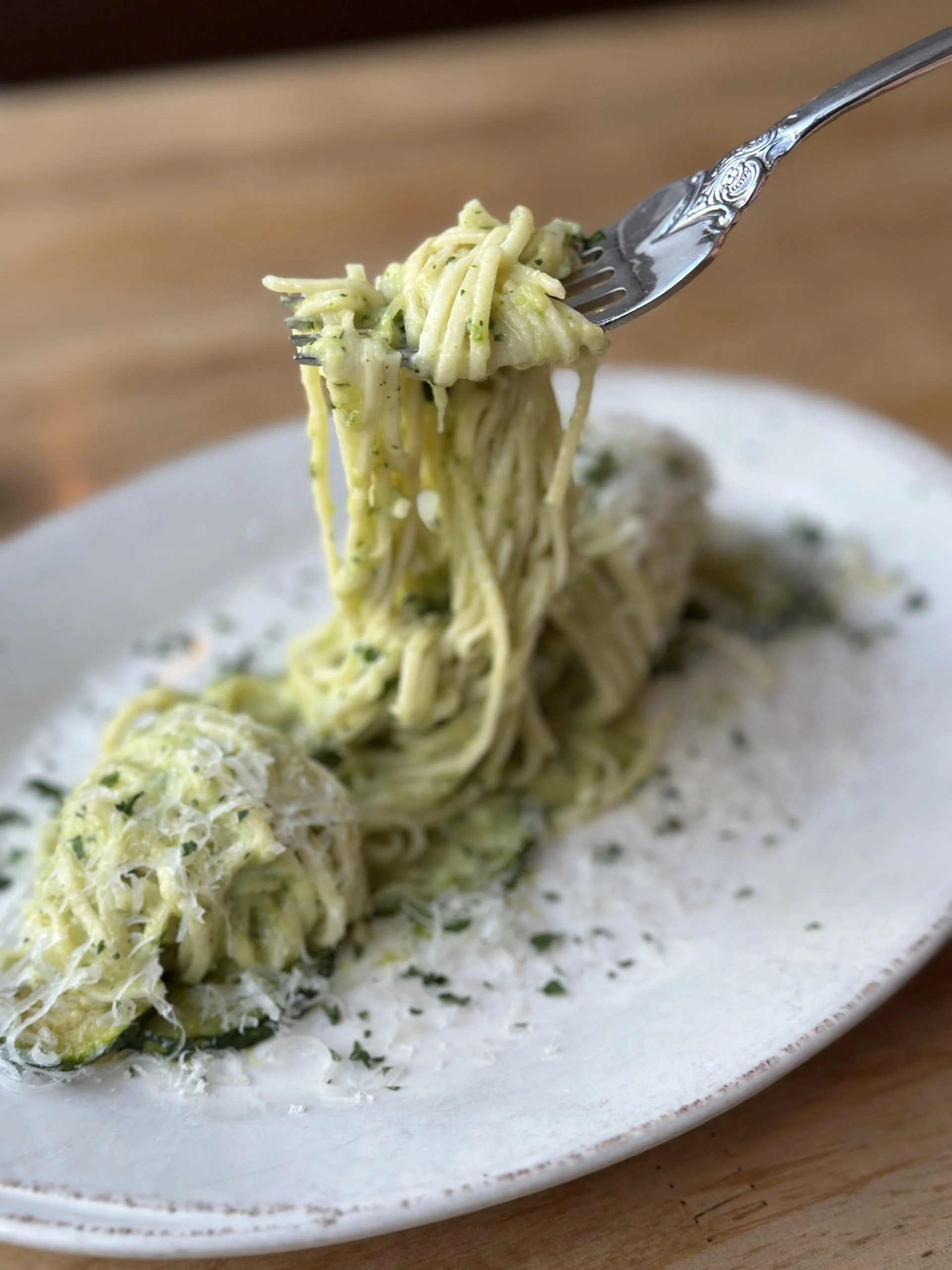
Then the Spaghettini alla Nerano—zucchini, basil, provolone, layered with a delicate richness by the parmesan. It was as beautiful to look at as it was to eat.
And then dessert—which, at Ever Andalo, became a delightful dilemma. I couldn't choose between the tiramisu and the cannoli of the day, so I did what any reasonable person would do: I split the difference. The tiramisu at the table, the cannoli to go. And since I was already bringing home the Calabrian chili pappardelle for my husband, I ordered their duo of cannolis for us to share.
The tiramisu was rich and creamy and beautifully presented—and I want to be fair, because it was good. But I'll confess it was the one moment of the evening where I felt a quiet want. The espresso punch I'm used to in a great tiramisu wasn't quite there. More whisper than exclamation.
The cannolis, however, were perfection. Ever Andalo had chosen apricot—and that choice alone told me everything I needed to know about this kitchen. When stone fruit appears in dessert it is almost always peach, plum, or cherry. Apricot is the rarer choice, the more considered one, and here it was exactly right: a beautifully spiced mascarpone filling inside a perfectly crisp shell, with that heavenly tartness from the apricot cutting through the richness in the most satisfying way. It made the conclusion of my evening—half at the table, half brought home to share—feel like a gift I'd given myself twice over.
Ever Andalo has always been a favorite of mine. Evenings like this one are exactly why.
Three restaurants. One evening shared, one rearranged, one claimed entirely for myself—three different versions of what a March evening can be. But the same undercurrent running through all of it—the particular pleasure of being somewhere that someone cared about, both deeply and visibly.
The Michelin recognition matters, and I don't want to dismiss what it means for this city and for the people who built these places. But what I'll carry with me from this month isn't a star or a rating. It's the way good food slows time. It's the reminder that a meal, when it's done right, is never really just a meal.
It's an Edit. A small, intentional pause to notice what matters.
And this March—over three tables in a city still earning my heart—I noticed quite a lot.
